My Friends, the Animatronics
Recently while watching a bunch of old FNAF YouTube videos, me and my sister found this YouTube channel, riko16riko16. From what I can gather they mainly make FNAF animations and mvs in SFM.
Their videos are, for lack of better words, awesome. Just utterly creative and inspiring work. What I specifically noticed about them is the way the animatronics are animated in a very “human” way.
That is, they don’t creak about rigidly or perform with the limited range of motion you would expect if you were actually trying to emulate a robot’s movement. Rather, they move dynamically like people. There’s still that SFM stiffness, but the animator does a great job hiding it. The animatronics embody the same poses and gestural ticks as if you were animating a person rather than a robot. If anything, the limitations of the software locking them at the joints gives them a grounded touch that makes them feel even more alive, like if they were real and somehow free from their programming they would prance around like that.
And this is something I’ve been thinking about for a while. Because in another context, like if it was a live action movie with a robot character where the point is to feel robotic, wouldn’t this just seem weird? Like why is this metallic thing gasping for air, or shifting about in their position, or just generally acting with any sort of human naturalism? Even if their robotic nature isn’t intentionally exaggerated, real life robots undeniably have limitations. Anyway, in something like FNAF where the core concept is that it’s freaky for the robots to act like living things, you’d want to emphasise on their mechanical nature, right?
Oh, wait. Yeah.
They’re living.
Possessed by human souls if you wanna be pedantic, but I think I’m not alone in thinking that the animatronics in FNAF being their own autonomous characters is a self-justified thing at this point. I mean, that’s probably why most FNAF artwork has the animatronics as the subject and not like, the human children.
That self-justification is such an important thing, because otherwise these types of work probably just doesn’t make sense. Coupled with the fact that FNAF animatronics are basically their own style of mecha at this point (did you know most real life animatronics are actually designed to conceal their machinery?). Being so removed from real life inspiration, it’s not unexpected that most people think the current FNAF media is just not scary. In fact, there are lots of fan games and fan works reimagining the characters with more obvious real life inspiration1.
The catch, though, is that normal people measure the movies and the games’ metrics by how scary it is. FNAF is still a horror franchise after all. What does it say about me then, that I wholeheartedly enjoy the movies not because they’re scary, but because I get to see the animatronics hang out and play with the human characters? The “creepy animatronic” premise is a really mainstream perspective2 and also has been parodied to death, I think it’s kinda impossible to play it straight anymore. So I’m actually glad the movies don’t try to reinvent the wheel. Like be serious, you’re not going to walk into the Five Nights at Freddy’s movie and be surprised that the animatronics are alive.
I digress, but the common comment/critique of the movies being only enjoyable by fans does point to what I mean by self-justification. I don’t particularly care if the plot is absurd or the lore doesn’t make sense, because my enjoyment of the movie isn’t reliant on that kind of scaffolding. I don’t need the plot to justify why we’re making a pillow fort with the animatronics, it’s self-justified!
So returning to riko16riko16’s animations, this self-justification is what allows their animation to become wholly aesthetic pieces. The animatronics don’t need to concede to any “logical” limitations or even the lore of FNAF, but rather are just vessels for artistic expression. Playing with the animatronics like dolls is just a natural evolution of how we appreciate the animatronics not as the unfamiliar Other to be feared, but rather as a familiar representation of ourselves.
I don’t even think it’s that much of a stretch of a concept. Like just thinking about it symbolically, is the idea of something cute and cuddly on the outside being not only unrecognisable but terrifying on the inside not easy to resonate with?
Emphasising the mechanical aspect of the animatronics would arguably be more interesting, by pushing our perspective to explore the ways something non-human would navigate a world catering to human desires. On the other hand, there’s also merit in using non-human characters as vessels of human desire themselves, it allows us to engage more deeply with what we even consider to be human in the first place.
In their animation, “BUILD THE ROBOTS”, Springtrap is depicted building animatronics in an isolated workshop. In his continued quest to make the same robots over and over, he becomes one himself. He replaces an injured arm with a mechanical one, and later he can’t feel pain in the other. He becomes as mechanical as the machines he created, losing both bodily and mental function, he becomes less human.
The video is labelled as a FNAF animation, but the characters really only act as vessels for an otherwise original story. And that alone contributes to it symbolically! Pay attention to the differences in how the robots and Springtrap himself are animated. I hope this explains what I mean by exploring what it means to be human.
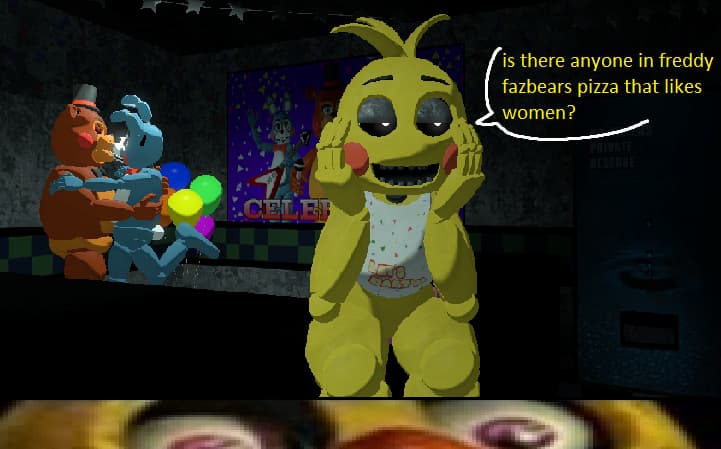
I think that’s all I have to say about FNAF for now, because if I write another blogpost about this franchise I might lose my mind. Other parodying yet entirely original works similar to this include Spikes by Marlo Mogensen, as well as The Pervert by Remy Boydell and Michelle Perez. Special shoutout to Loyal Hound Vesna: Dogs to Watch Out For by Mia Cain for eliciting a similar reaction from me.
Off the top of my head I can think of that one fan game and this person doing Don Bluth redesigns.↩
Ironically FNAF is probably the main contributing factor to that.↩